
The Fringe walk- 2026

Ten Months Between Boots and Hills
There was a gap of ten months in my life between my boots and the hills. Technically, it was only ten months, but emotionally it felt much longer. I spent many days and nights in turmoil. The longer I stayed away, the more dangerous that gap became. I knew one thing very clearly: if I continued to stay away, I would slowly walk into darkness. I could not imagine living a life without the light that the mountains had always given me.
Coming back was never a difficult decision. I simply needed the courage to reconnect with myself. Sometimes, a break is necessary. It allows us to pause, reflect, and return with a renewed purpose.

Sunil spoke about a trail that did not really exist as we were having a discussion about a trail to relaunch our activities. There was no marked path, no destination board, no tourist attraction, and no established trekking route. There was only a beautiful landscape waiting to be explored. That was enough for me.
I never discouraged the idea because I knew that many meaningful journeys begin from nothing.
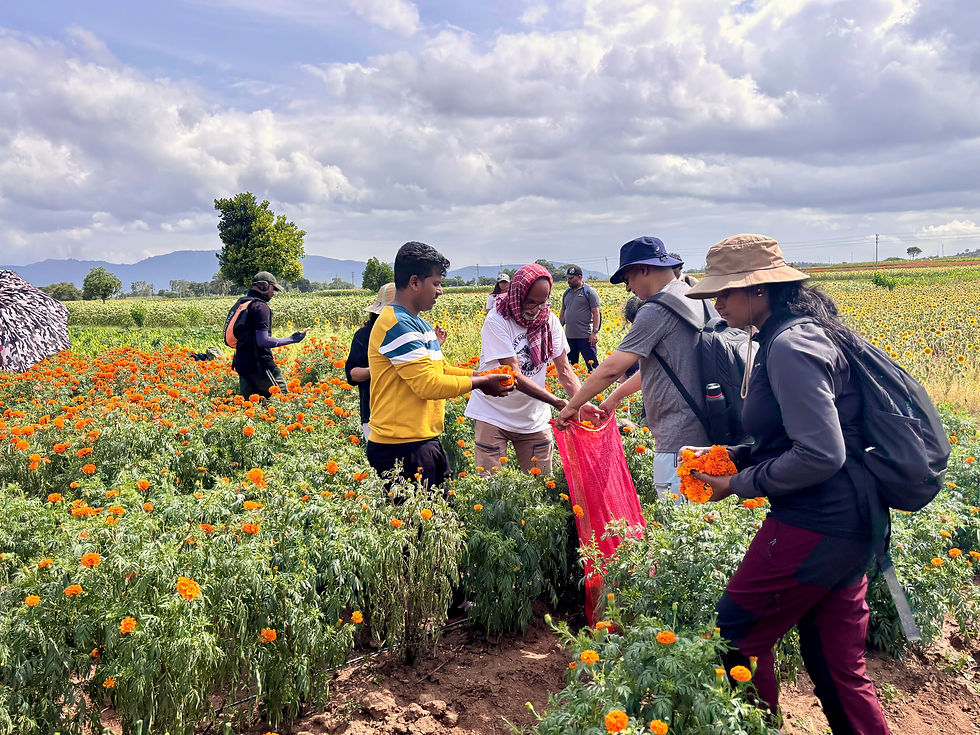
Tourism in Gundlupet is still in its infancy. A few farmers along the National Highway allow visitors into their marigold fields after collecting a small entry fee. Beyond that, there is hardly any organised tourism. The villages continue to live their simple lives, untouched by commercial tourism. Ironically, that simplicity became our greatest attraction.
Sunil contacted one of his friends from the village, and we began discussing the possibilities. We had very little time to act because we wanted to announce a trek that would also mark our return.
Choosing Wayanad during the monsoon was never a practical option. The rain was not the real concern. Administrative restrictions and safety advisories during weather alerts could easily disrupt our plans. We did not want uncertainty to become another obstacle. So we looked beyond Wayanad.
Other districts offered a few possibilities, but none of them felt right. We wanted a place that had its own charm, a place that deserved to become the starting point of our new journey after such an unexpectedly long silence.
I spent several days studying maps, imagining routes, and connecting landscapes in my mind. Some ideas looked promising on paper but disappeared the moment they met reality. That is how exploration works.
Finally, I decided to travel alone.
I drove to Gundlupet, met local people, walked through villages, listened to stories, and slowly understood the landscape. Every conversation revealed something new. Every small path opened another possibility. Somewhere during that visit, strangers became friends, and an idea slowly became a plan.The trail had not existed before. But it was there.Perhaps that is exactly why it was worth creating.

Chapter 2: The Plan and Purpose
Globetrekkers is not just a community to trek with. It never has been.
The inception of this community was carved out of a simple mission: everyone should trek, and no one should be left behind.
Our community is deeply rooted in the belief that we should take care of seniors and help them climb more. We believe that the outdoors should never belong only to the young or the experienced. Nature belongs to everyone.
That is why we decided to make this walk accessible to all. Walking is one of the greatest therapies available to human beings. It costs nothing, asks for very little, and gives back far more than we can imagine. Perhaps it is the best medicine that nature has offered us, freely.
We conducted a reconnaissance and finally identified the route, now we were a team and did it purposefully. It became a perfect example of designing a community walk that aligns with responsible tourism and sustainability. Should I use such big words? Maybe not. We simply wanted to create something meaningful, something that respected both people and the landscape.
One thing, however, was non-negotiable.
We never compromised on the distance.
We are walkers, and walking defines us. Every trail should offer an experience, but we also believe that long walks create deeper experiences than short hikes. Our intention was to design a route of around 11 to 13 kilometres—long enough to challenge the body, yet comfortable enough for ordinary people to complete in a day.
Something remarkable happens when a group of strangers begins walking together over a long distance.

People slowly change.
They begin to look at life from different perspectives. Conversations become deeper. Opinions become softer. Everyone learns to adjust, compromise, and move together as a team. Without realizing it, the trail begins to reshape the mind as much as the body.
Perhaps that is the true strength of community trekking.
The trail quietly becomes a place where frustration is released, confidence is rebuilt, and friendships are formed. The impact does not end when the walk is over. It stays with us long after we return home.
As the route slowly came together, we realized that it had everything we had hoped for—vast agricultural fields, gentle hills, a peaceful lakeside, village roads, and the fringes of a forest.
At that very moment, The Fringe Walk was born. The idea suddenly had a name, and the name gave life to the experience. We had the support of the local community as Sunils friend became our host, and they served the hot Lunch. He became our guide as well. Nothing about the experience felt artificial. It belonged to the people who lived there.
Long walks have an incredible ability to help us forget the burdens of everyday life. For a few hours, deadlines disappear, phones become less important, and the mind begins to breathe again. Walking helps us reclaim a balance that modern life quietly steals from us.
At the same time, walking teaches us about ourselves.
It reveals the limits of our bodies. It shows us where we become tired, impatient, or uncomfortable. Once we recognise those limits, we also discover the opportunity to improve ourselves. That journey is not only physical. It shapes our behaviour, our attitude, and the way we respond to life. The social , emotional and physical wellbeing is the key.
Perhaps that is the real purpose behind every walk we organize.
The destination is never the only goal. The transformation along the way is.

Chapter 3: The Implementation
It was never about the flower fields.
It was never about the vibrant colours of the flowers.
The landscape may attract people with its vibrant colours, but the experience goes far beyond what the eyes can see. Many may remember the endless marigold fields, but for us, the real beauty lay beyond the colours. The walk was about people, conversations, and the quiet transformation that happens when we spend a day close to nature.
The villages in this region are gradually changing. The roads are reasonably good, and the basic facilities are available. Yet, they have managed to preserve their rural identity. As we walked through the villages, farmlands, and flower fields, it felt as though time had slowed down.
Beemanaveedu is the largest village in the region, with more than five hundred houses. The surrounding villages are much smaller, each with around eighty to one hundred houses. Every village has its own temple, traditions, and way of life. In many places, communities still live according to traditional caste-based settlements—one caste, one village. This is a part of rural India that continues to exist. Yet, despite these traditional social structures, the villages live peacefully, respecting one another and preserving their cultural identity.

The hills in this region are surprisingly underrated. Rising only about one hundred to two hundred metres above the surrounding land, they are ideal for both beginners and experienced trekkers. They are gentle enough to encourage first-time walkers and rewarding enough for those who simply enjoy being outdoors.
Our walk began at 9:00 in the morning and concluded at 6:00 in the evening. We rested for nearly one to two hours during the day; apart from that, we kept walking. By the end of the journey, the odometer showed nearly 15 kilometres. For many participants, especially the beginners and families, it was their longest walk ever. Watching them complete the distance with smiles on their faces was an achievement in itself.
Lunch became another memorable part of the experience.
Our host prepared authentic Karnataka village food with great care. The dishes were simple, flavourful, and cooked with fewer spices to preserve their natural taste. It was delicious, generous, and perhaps a little heavier than we expected. But nobody complained. Good food, shared with good people during a long walk, always tastes better.

Throughout the day, we walked, talked, laughed, and shared stories. It was enough to rejuvenate the mind—a gentle massage for the soul. One participant became tired during the walk, and the team naturally came together to support and encourage that person. That is what community walking is all about. Nobody walks alone.
We also had the privilege of walking alongside former Chief Secretary of Kerala state, Dr. Jayathilak IAS. Titles and positions mattered very little on the trail. Everyone became just another walker, sharing the same sun, the same dust, and the same destination. We exchanged stories, encouraged one another, and reminded ourselves why we should all continue to walk and trek more often.
We spent the entire day outdoors, immersed in nature. Perhaps it was not a true forest bath in the traditional sense, but it certainly felt like an immersion into peace and simplicity. Nature has its own quiet way of healing us, without demanding anything in return.
As the day drew to a close, we reached the lakeside and spent nearly an hour there. We sat quietly, refreshed ourselves, listened to the sounds around us, and allowed the silence to become part of the journey. The breeze carried the fragrance of the fields, and everywhere we looked, marigolds stretched across the landscape like a golden carpet.
The flowers may have framed the day. But it was the people, the walk, and the shared experience that made it unforgettable.
Chapter 4: The Learning

Walking is important.
Perhaps one of the simplest things we can do for ourselves is to walk more, and one of the greatest responsibilities we have is to encourage others to do the same.
The Fringe Walk was never designed merely as a trekking event. It began with an idea, and every idea deserves an opportunity to become reality. We came together as a team to discuss it, design it, and finally implement it. What started as a simple conversation slowly became a meaningful experience.
We carefully curated this walk so that anyone could participate and discover the magical elements of nature. Nature offers something that cannot be compared with music, comfort, luxury, or any form of addiction. It gives us something much deeper—a chance to reconnect with ourselves.
Away from walls, screens, deadlines, and distractions, we begin to hear ourselves again.
Perhaps this is one of the few places where we can truly nurture our minds, our bodies, and our inner selves. Nature quietly teaches lessons that no classroom can offer.
Then comes the most beautiful part of the journey—equality.
On that single trail, we walked with a former Chief Secretary, a National Film Award winner, scholars, professionals, senior citizen above seventy years of age, women, children, farmers, daily wage workers, and first-time trekkers.
What does this really mean?

It means that walking has the power to remove the invisible walls that society quietly builds around us.
On the trail, there are no designations.
There are no social hierarchies.
There is no difference between success and simplicity.
There are only people walking together towards the same destination.
That is the purity of humanity that only a shared journey can create.
When we walk together, we begin to understand one another. We listen more, judge less, and naturally become more patient. Unity is not created through speeches. It is created through shared experiences. That is perhaps the greatest gift a community walk can offer.
Every trail also becomes a classroom.
The harsh sun is a lesson.
The loose gravels in the hills are a lesson.
The long distance is a lesson.
Walking with strangers is a lesson.
Waiting for someone who walks more slowly is a lesson.
Sitting on the ground together to share some stories is a lesson.
Every small experience quietly shapes us.
By the end of the day, we realise that trekking is not really about reaching the destination. It is about becoming a slightly better version of ourselves than we were in the morning.
If there is one lesson that every trail teaches, it is this:
Life does not always become easier. We simply become more adaptable.
And perhaps adaptability is one of the greatest strengths a human being can possess.
Chapter 5: Final Note
Every activity of Globetrekkers will always have a purpose.
We are not here merely to organise walks or climb mountains. Every journey we undertake is purpose-driven, designed to help people discover not only the beauty of nature but also the strength within themselves. Every trail is an opportunity to learn, to grow, and to become a little more human.
We do everything together.
That has always been our philosophy, and it will continue to guide us.
As we walk through villages, hills, forests, farms, and lakesides, we remind ourselves of one simple truth—we are not the owners of this land. We are only visitors, passing through it with gratitude and respect. The mountains existed long before us, and they will remain long after we are gone. Our responsibility is not to conquer them, but to learn from them.
Every walk teaches us humility.
Every climb teaches us patience.
Every trail teaches us resilience.
Nature never speaks loudly, yet it has the power to transform those who are willing to listen.
We believe that walking is one of the simplest ways to reconnect with ourselves. It slows us down, clears our thoughts, strengthens our bodies, and reminds us that happiness is often found in the simplest moments—a shared conversation, a helping hand, a village meal, a quiet lakeside, or the silence of a hill.
These are the moments that remain with us long after the photographs are forgotten.
We will continue to climb.
We will continue to walk.
We will continue to encourage people of every age and every background to step outdoors and experience the healing power of nature.
Because every trail has a story.
Every walk has a purpose.
And every person deserves the opportunity to discover both.
We return home with tired legs, lighter minds, grateful hearts, and a deeper respect for the people we walked with and the land that welcomed us.
That, perhaps, is the true meaning of every journey.
Not how far we walked.
But how deeply the walk changed us.
Unity is not created through speeches. It is created through shared experiences
We don't just walk through landscapes. We allow landscapes to walk through us

Shaji P Mathew.
12-06-2026
Comments